
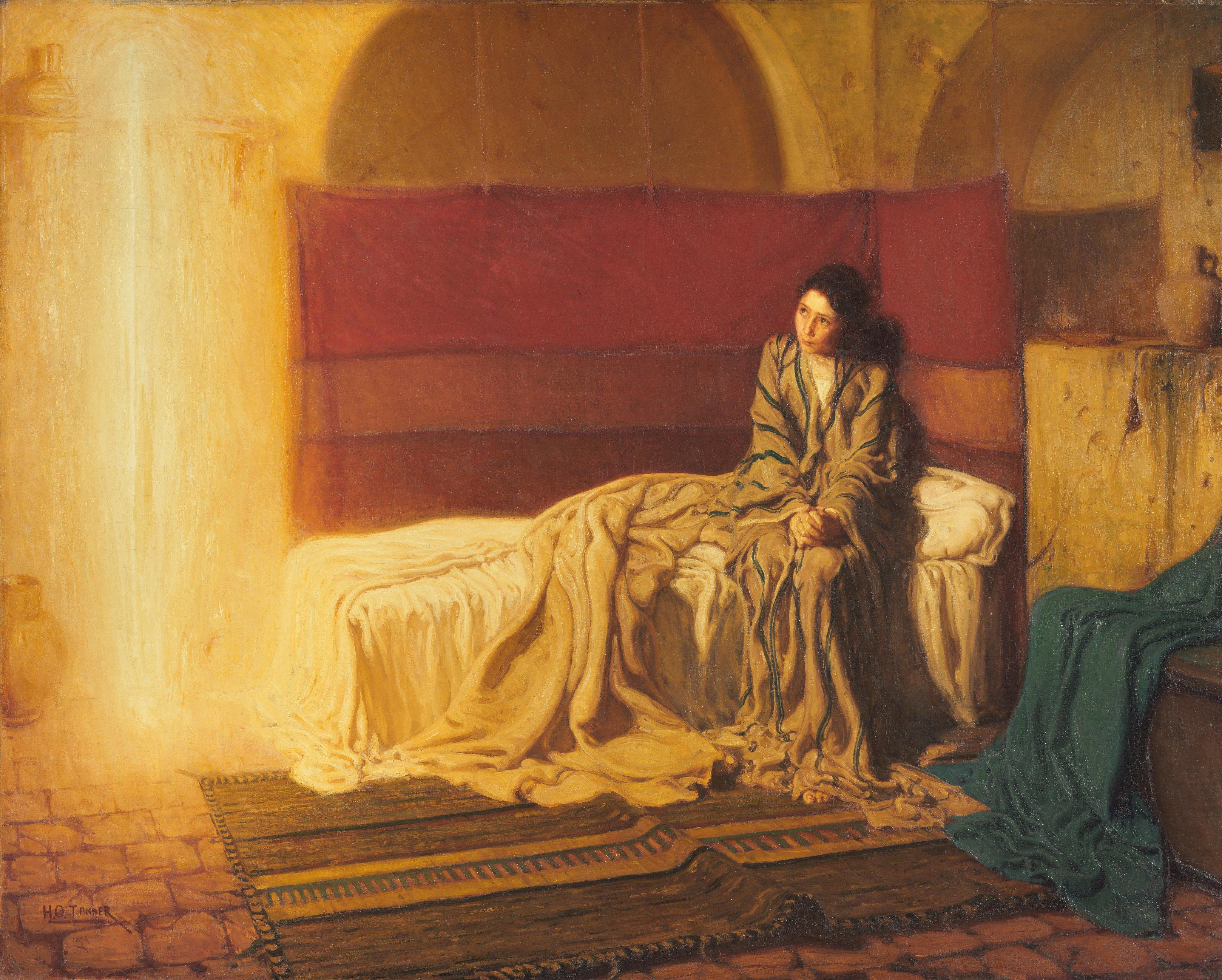
The Solemnity of the Annunciation to Mary is one of my favorite feasts to celebrate, as it has become one of my favorite Gospel passages to pray with (Luke 1:26-38). Luke’s account of the Annunciation is jam packed with Old Testament imagery, messianic expectation, theology and doctrine—all of the necessary things to make a nerdy Scripture scholar do back flips (if one could).
What makes this account so special for me, though, is drawing inspiration from what I like to refer to as “Mary’s moment,” which happens near the end of the scene: “And the angel said to her in reply, ‘The Holy Spirit will come upon you, and the power of the Most High will overshadow you. Therefore the child to be born will be called holy, the Son of God’” (Luke 1:35).
Assuming that the angel’s message came true, it would follow from his words that soon if not immediately upon his departure, a moment in occurred in which this ‘overshadowing’ took place. That, alone, is enough to flood the soul with graces: imagining what that moment was like, praying for the same receptivity of the Holy Spirit, etc.
But when you account for the biblical imagery that is bursting through the seams of that specific word, “overshadow,” the power of that single moment intensifies exponentially. Let’s break it down a bit.
In the original account of creation (Genesis 1–2), we observe God acting according to a pattern, a pattern in which he would act similarly over and over again throughout salvation history. The pattern goes something like this: God steps onto the scene, brings about a newly created person/people in a newly given place, for the singular purpose of enjoying covenant dwelling with and among his people. In Genesis, he does this all in new and brilliant ways: he steps onto the scene as the only One in existence, brings form to the formless, brings life into the void, culminating in the pinnacle of creation, man and woman. Having created these chosen persons, he places them in a new land (or, Garden), and enjoys covenant communion with them (he walks with them “in the cool of the day,” c.f. Gen 3:8).
“You’re still talking about the Annunciation, right?” Yes, I am. Stay with me.
After his chosen people—Adam and Eve—fell into sin, God initiated his saving rescue mission: a plan to not only save, but restore and elevate his people to a state of grace so that they would not have live eternally without him. Noah and the great flood follows a a similar creation pattern: new people (Noah and his family), new land (washed by the flood), covenant communion. Abraham, likewise: new people (Abraham and his tribe), new land (Canaan), covenant communion. A rollercoaster of stories and a few page turns later, we read of yet another similar occurrence, now seen in the saga of the exodus.
There are a lot of smaller building blocks that make up the larger story of the exodus, but let’s not lose the macrovision amidst the many mini-sagas tucked within: (1) God steps onto the scene: “I have surely seen the affliction of my people…and I have come down to deliver them” (Ex 3:7-8); (2) God calls forth his chosen people, Israel, out of slavery (19:4-5); (3) God prepares for Israel a new dwelling place (3:8); (4) finally, he does all of this solely for the purpose of redeeming and dwelling with his chosen people in covenant communion (3:18; 40:21, 33-38).
At the climax of this dramatic saga, we get one of the most powerful accounts in the Scriptures since God first created the whole world. After rescuing Israel out of Egypt and leading them through the Red Sea, the rest of the book of Exodus—nearly the entire second half—is one long preparation for this climactic moment in Exodus 40 where God accomplishes his creation pattern yet again and comes to dwell with his people—but this time in a way like none before. Take note of how God completes the story of the exodus:
“[Moses] brought the ark into the tabernacle…So Moses finished the work. Then the cloud overshadowed the tent of meeting, and the glory of the LORD filled the tabernacle. And Moses was not able to enter the tent of meeting, because the cloud abode upon it, and the glory of the LORD filled the tabernacle. Throughout all their journeys, whenever the cloud was taken up from over the tabernacle, the people of Israel would go onward; but if the cloud was not taken up, then they did not go onward till the day that it was taken up.” (Exod 40:21, 33-38)
In this vivid scene, the power and presence of God “overshadowed” the tent of meeting so that his presence would be seen and known among the camp of his chosen people. How amazing is this?! The God of creation, the very God who just dethroned Pharaoh and parted the waters just manifested his presence in the form of a miraculous cloud, visibly coming to rest in the midst of this chosen people.
This phrasing of God “overshadowing” only further emphasizes the uniqueness of this scene. The Greek word employed is episkiazō and it is only used this one time in the entire Old Testament to depict this special activity of the Lord. To have been present in that camp and witness the glory of the Lord descend out of the sky and cover the tent of meeting in the middle of the camp must have been a scene so profound that words would never suffice to convey its significance. Our God is truly the God of miracles.
Still an Annunciation blog? You bet. But it would be only half as meaningful if we at least didn’t establish this foundation. God works in manifold and miraculous ways, but that doesn’t mean he works without a modus operandi. His artistry always jumps off the page. Like watching Caravaggio play with light on a canvas, time and time again we see God’s pattern of creation and dwelling, of renewal and relationship.
As we have already seen, from Creation to Noah to Abraham and now to the Exodus account, God’s fingerprints are all over, should we only have eyes to see them. So should it really surprise us when we turn the page from Malachi to Matthew and behold there an all-too-familiar pattern recur as the climax of our salvation unfolds?
Once again, the Divine Artist steps forward onto the scene and does what only he can do best. In the flyover country of Nazareth in Galilee, God’s brilliance breaks forth and with the stroke of his power he brings about his best creation story yet. He sends his angel to a new chosen one, Mary, in whose womb will be his new and sacred dwelling place.
“How can this be?” we all ask, even Mary. And so comes about what has to be one of the most serene, powerful, and miraculous events to ever occur in human history: Mary’s moment. Gabriel answers the young woman, “The Holy Spirit will come upon you, and the power of the Most High will overshadow you. Therefore the child to be born will be called holy, the Son of God.”
You caught it, didn’t you? The Holy Spirit will overshadow Mary! Any guesses as to which rare, powerful Greek word is lurking behind our English version of it? You guessed it: episkiazō, the same exact word used back in Exodus 40 when the presence of the LORD visibly came down upon the ark of the covenant so to make his presence known among his people. Likewise, the Lord overshadowed his chosen vessel—his new Ark of the New Covenant—to manifest his presence, a presence among us as never before by assuming human flesh, so that he and his people can once and for all dwell together in covenant communion.
TL;DR: Mary’s Moment
And so we can now envision with new insight and profound appreciation what Mary must have experienced in the moments following the Annunciation. In the vast hillsides of Nazareth, she now stood alone, having just conversed with an angel, only to learn that she was now to become the virgin mother of her God and King. In a moment where, if it were you or me, panic would be lurking around the corner waiting for this moment of solitude to devour us, a different character stepped onto the scene for the young Mary.
She looked up, and beheld a cloud descending out of heaven. It shone brighter than the sun, with a light that no flame could ever replicate. It was vast and replete with life and splendor. It was as if this cloud was light itself. It continued its descent until finally it rested and overshadowed the woman, the Lover encapsulating the Beloved.
Enveloped in pure bliss, Mary experienced the Holy Spirit as no other human would for human history, save her Son. It is the experience that, I am sure of it, awaits each of us on the other side of the veil.
What Mary experienced in sight, though, we no less experience now in faith. This same Spirit rushes upon us at every beckoning. He strengthens us with a sacred seal upon our baptism and confirmation. He prays in and through us as we follow in the steps of Jesus and seek the face of our Heavenly Father.
I use this scene of Mary’s moment constantly to remind me of this when my senses fail to comprehend the power and presence of the Holy Spirit in my daily life. Today, I am all the more grateful for it.
Mary, Queen of Angels and Mother of the God of Miracles, pray for us to experience the Holy Spirit in new and powerful ways on this, your feast day.
Happy Solemnity. –JB
Leave a Reply